Within the last two weeks on a 500 mile (800 km) run I noticed both my ammeter and voltmeter twitching slightly. This is normally a warning that at least one of the carbon brushes within the alternator is in need to replacement. For at least 20 years I have been using Cargo brand carbon brushes that are made in Italy. Great quality overall but the downside is they are a bit soft, so they wear rather rapidly. The two brushes run against the slip ring. Brush One (adjacent to the voltage regulator) makes contact with the slip ring at its centre. Brush Two (adjacent the bridge rectifier) makes contact out towards the perimeter. Brush One will wear an insignificant amount, indeed since I installed it in June of 2008 the wear to date is only 0.5 mm in 242,547 miles (390,501 km)! The brushes when new are 12.5 mm in length. Brush Two will wear down to 9 mm or less in barely more than 15,000 miles (24,150 km). The absolute minimum length before the ignition warning light comes on and the ammeter shows a discharge is 7 mm, but sometimes this will happen at 8 mm. It comes down to the manufacturing tolerance of the little spring that exerts a force on the slip ring through the brush. Once the spring is fully extended, the force approaches zero and the brush must then be replaced.
Now you might be wondering why does brush One wear so slowly while brush Two wears quite rapidly, given they are made from the same material, and their springs are essentially the same. The answer is the distance that the slip ring travels in one revolution relative to the brush. Brush One is rotating on its axis if you will, meaning the slip ring travels essentially zero distance which in turn generates effectively zero wear. Of course, there is wear, but it is vanishingly insignificant. By contrast, brush Two with one rotation of the slip ring effectively moves a distance 2 PI r where r is the radial distance from the slip ring centre to the axis of brush Two. The total wear per slip ring revolution being a function of the force exerted by the brush spring, the distance of slip ring travel, and the friction coefficient, both static and dynamic. The equation that allows the volume of carbon lost due to wear for each revolution of the slip ring was first published by Archard (1953) covering contact and rubbing of flat surfaces. The volume V of material in cubic metres or cubic mm lost due to wear is: -
V = (KFd)/N where: -
K = wear coefficient (no units)
d = distance travelled per revolution of the slip ring relative to the brush in metres (or mm)
N = Brinell or Vickers Hardness test data for the softer of the two materials (copper or carbon) in N/m^2 or Pa
Archard J.F. (1953)
Contact and Rubbing of Flat Surfaces. Journal of Applied Physics, 24(8): p. 981-988.
https://doi.org/10.1063/1.1721448
The following photos provide an illustration of the process and the wear that was revealed.
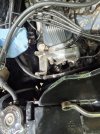
18ACR alternator removed.
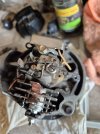
The voltage regulator can be seen at the top of the alternator. The bridge rectifier is at the bottom of the alternator. The two carbon brushes are housed within the brush box that separates the two.
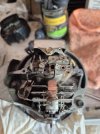
Brush Two has been removed. This is the brush, adjacent to the bridge rectifier that experiences the greatest wear.
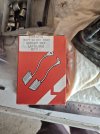
Rather than using Cargo brushes as I have been since 2007, I decided to try a NOS Lucas brush, to see if Brush Two will exhibit the same of a slower wear pattern.
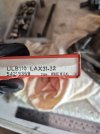
Lucas made in UK carbon brushes for 18ACR alternator
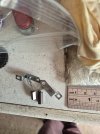
The worn brush Two (9mm) against the NOS Lucas brush (12.5 mm) revealing 3.5 mm of brush length lost in only 8 months (15,176 miles, 24,433 km) covered over that time frame.
Ron.